Zero-Cloud Migration: Bare Metal Kubernetes & GitOps
How we built cloud-native infrastructure from scratch on bare metal with full GitOps automation and banking-grade security.
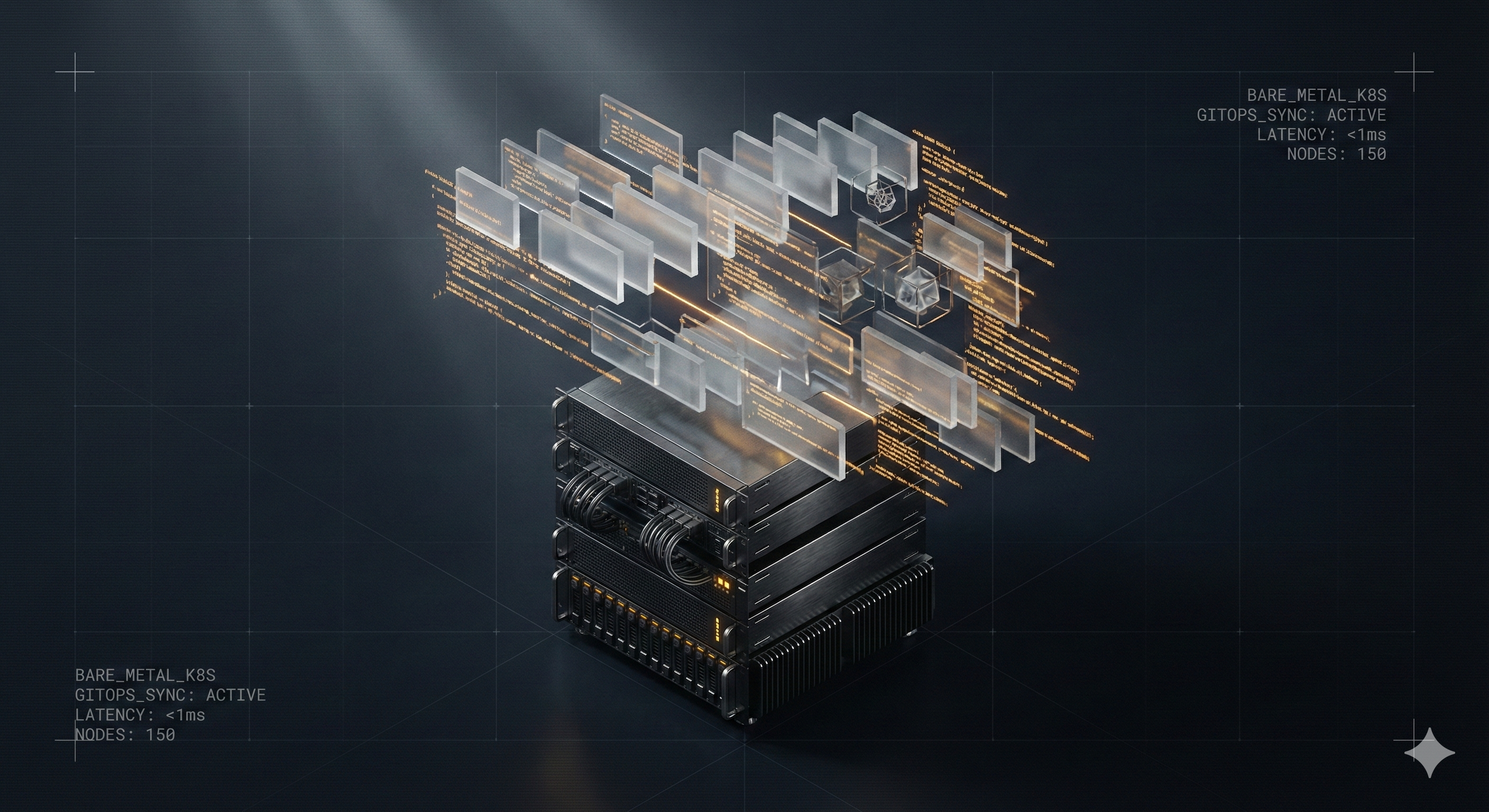
Key Results
The Challenge (The Constraint)
Business Pain
A highly regulated enterprise client needed the scalability of modern cloud-native apps but was legally prohibited from using public clouds (AWS/Azure) due to strict Data Sovereignty laws. They were stuck on fragile, manually managed legacy VMs that took weeks to provision.
Technical Pain
“Building the Cloud from scratch.”
- No Managed Services: We had no EKS, no RDS, no ELB, and no CloudWatch. We had to build the control plane ourselves.
- The Networking Void: On Bare Metal, there is no VPC. We had to solve Layer 2/Layer 3 networking, handling BGP routing and Load Balancing manually.
- Operational Toil: Deployment was a manual script-fest, error-prone, and took days to coordinate between Dev and Ops teams.
The Architecture (The Solution)
Strategy
A full GitOps implementation on Bare Metal Kubernetes. We treated the entire datacenter infrastructure as code (IaC), ensuring the state could be nuked and rebuilt from a Git repository.
The Logic
The Metal Layer (CNI/CSI): We provisioned a HA Kubernetes Cluster on private servers.
- Networking: Used Cilium (eBPF) for high-performance networking and security policies, replacing standard iptables. Used MetalLB in BGP mode to advertise LoadBalancer IPs to the physical corporate routers.
- Storage: Implemented a CSI driver for local path provisioning and Rook/Ceph for distributed block storage.
The GitOps Pipeline: We implemented ArgoCD as the source of truth. Developers push manifests to Git, and the cluster automatically syncs the state. We revoked direct kubectl access for humans to prevent configuration drift.
Observability Stack: Built a custom telemetry pipeline using OpenTelemetry (OTel) collectors running as sidecars/DaemonSets. These fed into a self-hosted Prometheus/Grafana stack, recreating the visibility of CloudWatch without the SaaS cost.
Zero-Trust Security: Implemented strict mTLS mesh (Linkerd/Istio) and Network Policies to isolate sensitive financial workloads.
The Outcome
- Strategic Independence: Vendor Lock-in Eliminated. The client owns the entire stack, saving 60% on comparable cloud costs (no egress fees, no EC2 premiums).
- Deployment Velocity: Shifted from “Monthly Release Nights” to “Multiple Deploys per Day” via GitOps.
- Resilience: Created a self-healing infrastructure where hardware failure is a non-event; pods simply reschedule to healthy nodes without human intervention.